

Quality & use of medicines
Reference standards
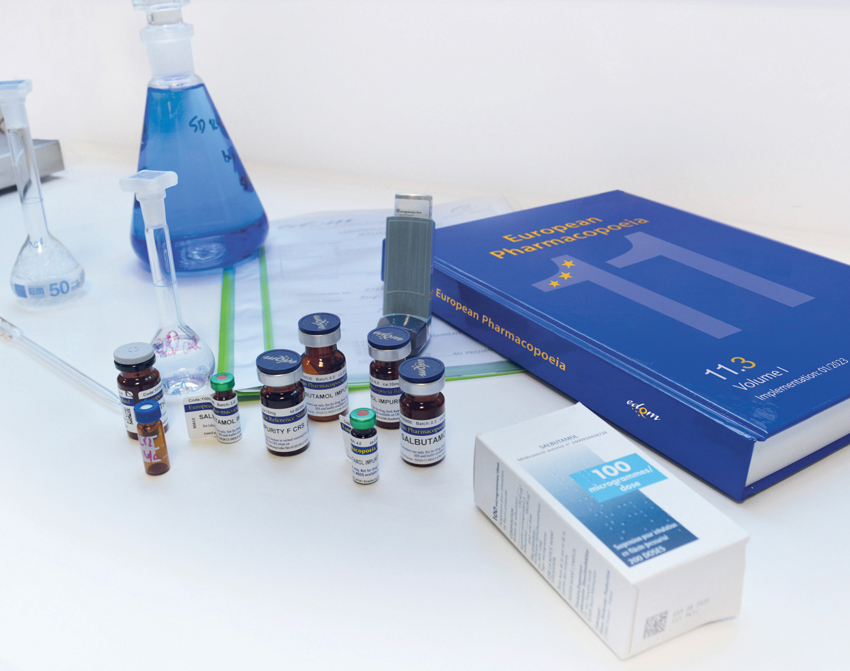
The EDQM ensures the supply of Ph. Eur. reference standards (RSs) to help safeguard the availability of quality medicines in Europe and beyond. Official RSs are an integral part of the Ph. Eur. since they are used in conjunction with Ph. Eur. documentary standards to perform the analytical procedures described in monographs.
Activities
The Ph. Eur. reference standard portfolio consists of 3 171 RSs. In 2023, the European Pharmacopoeia Commission (EPC) adopted 235 RSs based on establishment reports submitted by the EDQM Laboratory.
The EDQM distributes its RSs worldwide and its portfolio is constantly evolving: new standards are regularly introduced to be used with new or revised Ph. Eur. texts, or to replace existing RSs when corresponding stocks run out. The overall life cycle management of the RS portfolio involves a wide variety of tasks, ranging from the procurement of candidate materials, characterisation and establishment, to manufacturing, quality control, quality assurance, release, distribution and monitoring.
The EDQM distributed Ph. Eur. RSs directly to 135 countries in 2023 (131 in 2022).
Joint programmes
The international collaborative studies (co-funded by the European Union) performed in 2023 as part of the Biological Standardisation Programme (BSP) led to the adoption of four reference standard replacement batches:
- Establishment of Immunoglobulin BRP replacement batches (BSP150)
- Establishment of Erythropoietin for physicochemical tests CRS replacement batch (BSP159)
- Establishment of Hepatitis A virus coating reagent for ELISA BRR replacement batch (BSP165)
- Establishment of Prekallikrein activator in albumin BRP replacement batch (BSP167).

International co-operation
Collaboration with WHO
The EDQM is responsible for establishing, manufacturing, monitoring and distributing WHO International Chemical Reference Substances (ICRSs). Currently, the ICRS catalogue consists of 212 RSs. ICRSs are used worldwide in conjunction with the texts of the International Pharmacopoeia, which is published and maintained by the WHO Expert Committee on Specifications for Pharmaceutical Preparations.
In 2023, the WHO ECSPP adopted two new ICRSs based on establishment reports submitted by the EDQM Laboratory. In addition, nine reports were issued on the verification of the suitability of RS candidates (and/or corresponding establishment strategies) and another two on feasibility studies of production by advanced manufacturing techniques.
The EDQM is also responsible for establishing, manufacturing, storing and distributing WHO International Standards for Antibiotics (ISAs), which are essential for the standardisation and quality control of antibiotic drug substances and medicinal products. There are currently 24 RSs in the ISA catalogue.
Collaboration with ISO
The EDQM continued its participation as liaison organisation in the activities of ISO/TC 334, the ISO Technical Committee on Reference Materials.
Collaboration with national laboratories
The EDQM Laboratory can count on a number of official laboratories for support when collaborative studies are required for the establishment of Ph. Eur. reference standards. In 2023, 27 official medicines control laboratories, representing 22 countries, enrolled in such RS establishment studies.
Publications, databases and website
Throughout 2023, the EDQM continued to run and maintain its Reference Standards Online Database (https://crs.edqm.eu), providing access to all reference standards officially valid for the uses prescribed in Ph. Eur. monographs. RSs can be searched by code, name, monograph number or CAS number. In addition, RS batch validity statements are available to users to document the validity of the particular RS batch supplied at the time of use. Downloadable Safety Data Sheets and Biological Safety Data Statements, as well as leaflets, are also available in the EDQM’s online database.